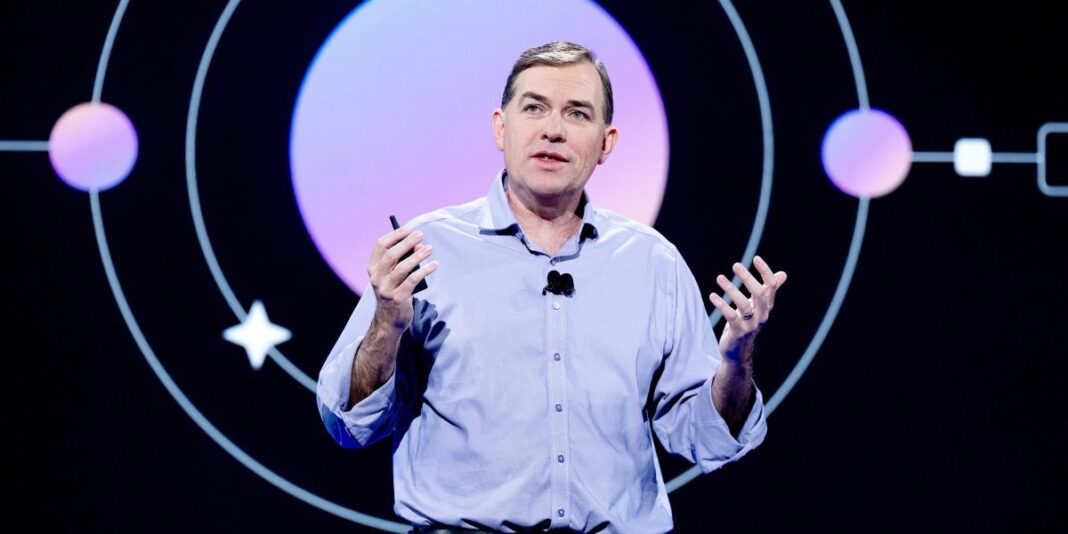
Speaking at a tech conference in San Francisco on Tuesday, Garman threw some cold water on the notion of space-based data centers, which have been touted by Elon Musk and others as the future of AI.
While putting AI data centers in space has obvious benefits, including the ability to harness energy directly from the sun and the ability to cool the heat-generating equipment in the cold atmosphere of space, Garman said there are also some big obstacles to putting data centers in space or on other planets. Chief among them is the cost of transporting equipment.
“I don’t know if you’ve seen a rack of servers lately: They’re heavy,” Garman said in an interview at the Cisco AI Summit in answer to a question about the viability of space-based data centers. “And last I checked, humanity has yet to build a permanent structure in space. So … maybe.”
The comments come one day after Musk announced the merger of SpaceX, his rocket company, with his AI company, xAI, in a deal that reportedly values the combined companies at a staggering $1.25 billion.
“The capabilities we unlock by making space-based data centers a reality will fund and enable self-growing bases on the Moon, an entire civilization on Mars, and ultimately expansion to the Universe,” Musk wrote in a blog post Monday announcing the deal.
The modern data centers that power AI services, including chatbots like OpenAI’s ChatGPT and xAI’s Grok, are massive behemoths that can span millions of square feet and are packed with so much hardware that they have to be built on top of reinforced concrete slabs.
Musk’s SpaceX has a successful track record of launching thousands of its internet-beaming Starlink satellites into orbit on its Falcon rockets, and Musk has floated ambitious plans to use its Starship rocket to launch as many as 1 million satellites into space—an amount that’s far greater than the total number of objects launched into space in history. The blizzard of Starlink launches would lead to improvements in SpaceX’s rockets that will make space based data centers a reality, Musk wrote on Monday, though he did not provide a timeline for when he expected it to happen.
Amazon has plans to create a constellation of internet beaming satellites, dubbed Leo, to compete with SpaceX’s Starlink. The company has earmarked $10 billion for the project, according to CNBC, but progress has been slow, with Amazon recently asking the U.S. FCC to extend the timeline to launch 1,600 Leo satellites.
Garman cited Musk’s 1-million-satellite plan during the Tuesday talk, and acknowledged that improvements in fuel and other aspects will make transportation into space less expensive. But for now, he stressed, the costs are a major bottleneck.