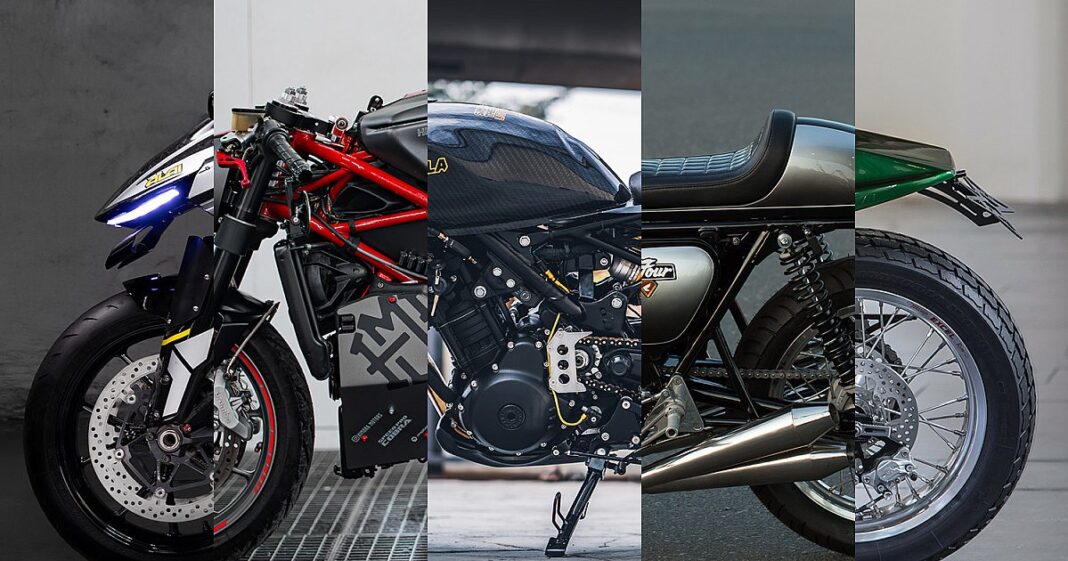
January marked the start of another new year, and as we turn the page to February, it’s time to take a look back at our most-viewed custom motorcycles of the last month. Once again, the donors are completely different than last month, except for another strong showing by Royal Enfield—a brand that continues to stake a hefty claim in the custom motorcycle scene.
A diverse group of exceptional customs, join us for one last hoorah for our top performers of January 2026.
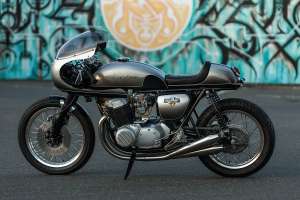
1973 Honda CB750 Four Café Racer by Jeez Louise! Motorcycles
The 1973 Honda CB750 Four doesn’t need myth-making—it earned its place the hard way. Widely credited as the first true superbike, it reset expectations with four cylinders, electric start and real-world reliability at a time when consumers weren’t used to having it all. It was the bike that forced the industry to recalibrate, and half a century on, it still carries that quiet authority.
This particular CB750 lived a full and messy life. Originally owned by a man named Billy, it passed through the era’s greatest hits—stock form, a period chopper conversion, endless miles and eventually a rough attempt at turning it into a café racer. Time was unkind. The result was less of a purposeful classic and more confused survivor, battered but not broken.
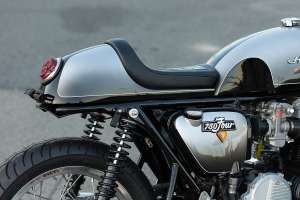
Advancing in years, Billy handed the bike to Andrew Peters of Jeez Louise! Motorcycles in Victoria, British Columbia instead of scrapping it. In Billy’s own words, ‘there’s at least three parts worth saving,’ so Peters approached the project with restraint and respect, stripping the bike back and rebuilding it with a clear vision.
New fairings, a sharp paint scheme and a careful mix of restored, custom and modern parts gave the Honda its dignity back, while incorporating the three good parts Billy mentioned—the smoothbore carbs, custom-built stainless steel pipes, and one-off mystery gas tank.
Crucially, the CB750’s engine and core controls remain stock, preserving the character that made the model legendary in the first place. Subtle upgrades like LED lighting and a GPS speedometer bring it into the present without shouting about it. The finished bike feels honest, usable and intentional—a reminder that true classics don’t need reinvention, just the right hands and a steady eye. [More]
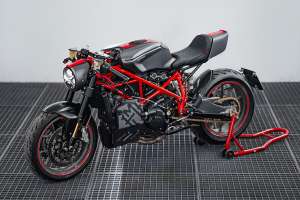
Ducati 749S Café Racer by Himora Motors
The Ducati 749S had always been a polarizing sportbike—sharp looks, stacked headlights and styling that split opinion when it debuted alongside the 999—but underneath it was a capable machine with stiffer chassis geometry, Brembo brakes, adjustable Showa suspension and a potent Testastretta motor that still holds up today.
Himora Motors in Germany saw something more than just a sportbike hiding under radical 2000s bodywork, so they set about reimagining the 749S as a modern café racer that still packs a punch. Rather than leaning into retro cues, their build emphasizes the desmodromic L-twin’s performance roots while stripping away everything unnecessary.
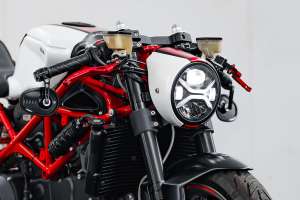
The fairings came off first, exposing the elegant trellis frame, and a handmade subframe went on to carry a lean solo seat and tidy tail. A custom LED headlight in a 3D-printed nacelle sits up front, the stock dash was ditched for Motogadget instruments and controls and the license plate hangs from a bespoke bracket behind the rear wheel. While the stock fuel tank remains, its character is entirely reshaped with the stock fairings omitted.
Underneath it all, the core Ducati equipment remains untouched—suspension, wheels, brakes and that 110-hp L-twin—but Himora added a burly two-into-one-into-two exhaust. A split white and gunmetal livery with red and carbon highlights gives the bike opposing character from right to left. According to Kay, the Ducati 749S’s livery is inspired by “the devil—adrenaline and speed—and the angel—riding safe and with your brain—inside every biker,” a concept all of us understand to some degree. [More]
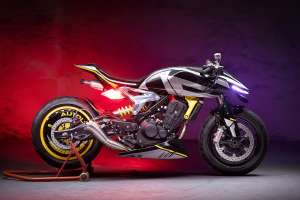
Royal Enfield Guerrilla 450 by Autologue Design
The Royal Enfield Guerrilla 450 was already turning heads as a scrappy street roadster thanks to its liquid-cooled 452 cc Sherpa single and minimal, muscular roadster stance and everyday practical grit. But what Autologue Design unveiled with the Guerrilla 450 ALX pushes that idea into a wild new realm—a concept that started on screen and evolved into metal and carbon, a prototype-level machine that feels like a factory dream.
Autologue was invited to reinterpret the Guerrilla for Royal Enfield’s Busted Knuckles Build-Off, and they treated it like a clean sheet project while still keeping threads of the original DNA. The custom bodywork is forged carbon with a kinetic silver and yellow scheme, and the frame and subframe were reshaped to carry an aggressive tail and purposeful ergonomics. A sharp, adjustable fairing with winglets gives the front end a streetfighter feel, while the 3D-printed TPU seat and waspish rear hint at race-ready intentions.
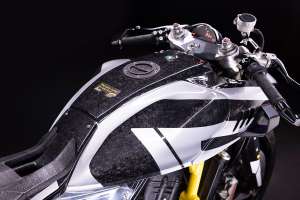
Calling back to the company’s roots in drag racing, the build has muscular lines, all developed in the company’s in-house AI design platform, YOURALAI. To make sure the chassis matched that energy, Autologue pulled Öhlins forks and Brembo brakes from a Ducati 848 for serious stopping and control, wrapped in sticky Pirelli Rosso IV tires, and added a GP-style stainless steel exhaust. The cockpit is clean and modern with Motogadget controls, simplified switches and bar-end mirrors, and a Bluetooth-enabled dash that talks to your smartphone for keyless start, geo-fencing and alarm functions.
This isn’t just carbon body panels and decals—there’s a bit of theatrical flair too, from integrated LED lighting with acrylic lenses to a dry nitrous system under the tail that’s meant to underscore that this bike is built to perform, not just pose. The Guerrilla 450 ALX took home top honors at the build-off, a milestone for Autologue as they shift perception from bolt-on kit makers to full custom design and prototyping. [More]
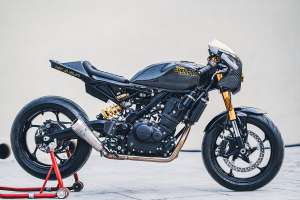
Royal Enfield Guerrilla 450 Café Racer by Buraq Motorcycles
The Royal Enfield Guerrilla 450 might be positioned as a modern street roadster, but its proportions and mechanical honesty make it an easy target for reinterpretation. In Hyderabad, India, Buraq Motorcycles took that idea seriously, reworking the Guerrilla into something sharper, lower and far more aggressive, seamlessly blending café racer and drag racing flavors.
The transformation starts at the rear. The stock subframe was cut away and replaced with a custom trellis unit that tightens the silhouette and supports a sculpted carbon fiber seat cowl. Beneath it sits a neatly packaged electronics tray and a bespoke shock mount paired with an Öhlins rear unit, giving the bike a poised stance that looks fast even at a standstill.
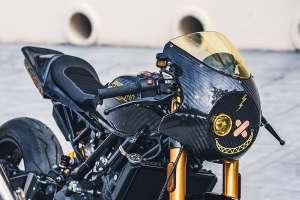
Up front, Buraq leaned hard into classic café racer language but filtered through a modern lens. Mirroring the factory hardware, a carbon-fiber fuel tank cover sits over an aluminum reservoir. The carbon fairing is handmade, wrapping around a tinted BMW R 12 nineT screen and offset LED headlight. Serious handling upgrades include Yamaha R1 forks, a BMW steering damper and uprated braking components front and rear. It’s a front end built for commitment, not cruising.
Performance tweaks back up the visuals. A PowerTRONIC ECU, quick-shifter, custom intake and a stainless exhaust capped with a titanium Arrow muffler wake up the 452 cc single. Clip-ons, rear-sets and a lighter overall package sharpen the riding position, while subtle gearing changes add urgency. Finished in deep black with carbon fiber and yellow highlights, this Guerrilla feels less like a styling exercise and more like a focused rider’s machine, and impressed Royal enough to secure a silver medal at the Busted Knuckles Build-Off late last year. [More]
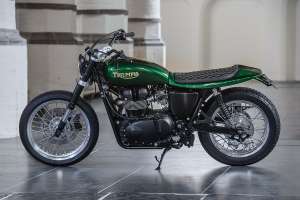
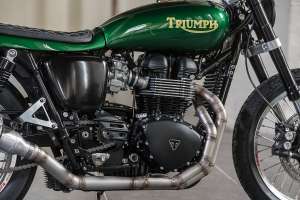
Triumph Bonneville Street Tracker by RNO Cycles
RNO Cycles is known for bold, over-the-top builds, machines that push the limits of imagination and metal. But for this Triumph Bonneville street tracker, a repeat customer wanted something more restrained—a bike that still had presence and attitude, but didn’t scream for attention. RNO took cues from clean, functional machines like Mule’s street trackers, focusing on proportion, purpose and subtle aggression rather than wild flourishes. The result is a bike that balances track-inspired energy with everyday usability, a street tracker that feels measured yet ready to move.
That mindset dictated the big visual decisions from the start. Instead of fabricating a tank or reshaping the stock Triumph unit, RNO modified a Yamaha XS650 fuel tank, chosen for its slim profile and natural tracker proportions. The tank was reworked internally and underneath to accommodate the Triumph’s fuel pump, allowing modern EFI hardware to disappear inside a classic silhouette. It’s the kind of solution that looks obvious once finished, but takes real restraint and experience to execute cleanly.
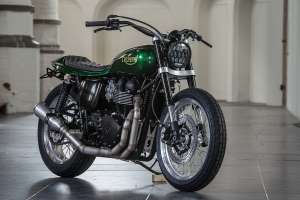
The seat follows the same philosophy of understatement. An aftermarket steel seat pan was reshaped to flow directly off the XS650 tank, topped with a slim leather pad that keeps the rear of the bike light and uncluttered. There’s no exaggerated tail or visual theatrics here—just enough structure to finish the line and support a passenger, reinforcing the bike’s intent.
Up front, the Bonneville sheds its stock suspension in favor of custom CNC yolks with Kawasaki Z1000 forks, rebuilt and tuned to suit the bike’s geometry and street-tracker role. Combined with wide handlebars, simplified controls and a pared-back cockpit, the front end gives the bike a planted, purposeful stance.
The engine remains mechanically stock, but a handmade stainless exhaust sharpens the soundtrack, while 19F/18R Excel wheels and purposeful rubber complete the look. It’s a quiet build by RNO standards, but that’s exactly the point—a controlled, confident machine that proves restraint can be just as compelling as excess. [More]