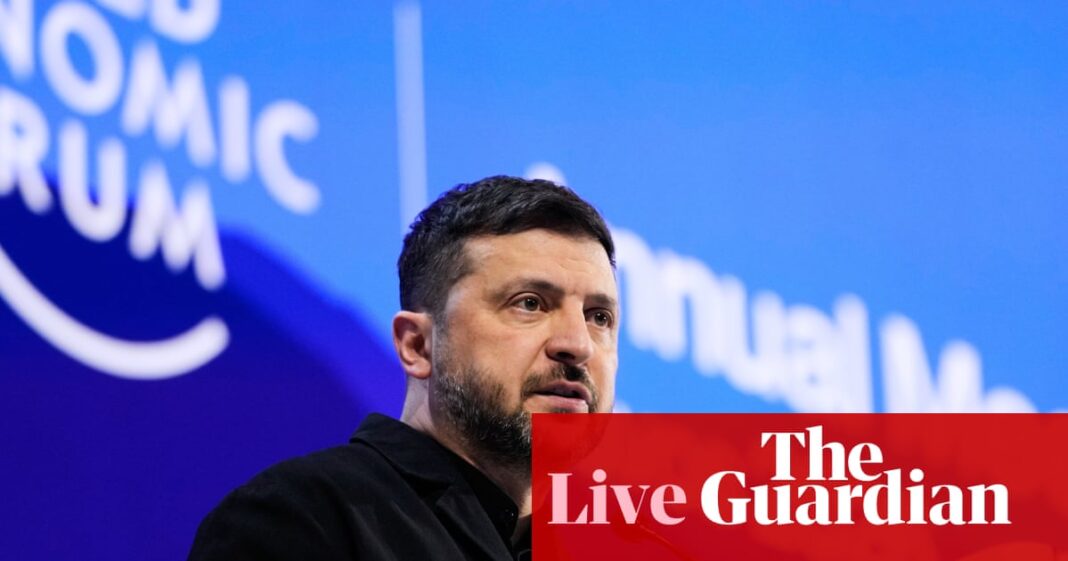
Ukraine, US, Russia to hold talks in UAE over weekend, Zelenskyy says
Zelenskyy then says the US delegation waited with travelling to Moscow to take to him first, and he talks about trilateral technical Ukraine, US, Russia meetings in the United Arab Emirates later this week.
He says it will be the first trilateral meeting of this sort and that he hopes Russia will be ready for compromises and this will lead to the end of the war.
Key events
-
French navy boards alleged Russian shadow fleet tanker in Mediterranean, Macron says
-
Zelenskyy takes Carney’s ideas and translates their meaning for Europe in urgent, wake-up call speech in Davos – snap analysis
-
Ukraine, US, Russia to hold talks in UAE over weekend, Zelenskyy says
-
‘Last mile’ is ‘difficult,’ but Zelenskyy praises ‘good’ talks with Trump
-
Documents aimed at ending Ukraine-Russia war ‘nearly ready,’ Zelenskyy says
-
Zelenskyy urges leaders to act and make Europe ‘global force’
-
‘You can’t build new world order out of words,’ Zelenskyy tells European leaders
-
Europe remains ‘beautiful but fragmented kaleidoscope of small and middle powers’
-
Zelenskyy criticises EU’s soft response on Greenland, calls for serious approach to Arctic security
-
‘Nato exists thanks to belief that US will act,’ Zelenskyy warns, as he asks ‘what if not?’
-
Zelenskyy criticises Europe’s inability to focus, respond to challenges
-
‘Everyone waiting for America to cool down’ on Greenland, Zelenskyy says
-
Ukraine has been living through its ‘Groundhog Day’ for ‘weeks, months, years’ under Russian aggression
-
Zelenskyy about to speak at Davos after Trump talks
-
European parliament to consider its decision to freeze ratification of EU-US trade deal next week
-
Trump warns Europe against dumping US treasury bonds
-
‘War has to end,’ Trump says after Zelenskyy talks
-
Greenland ‘deal’ has been always available to US and questions remain if it will stick – snap analysis
-
Plan for Greenland could involve rewriting 1951 Greenland treaty between US and Denmark – snap analysis
-
Nato’s Rutte says he didn’t discuss Danish sovereignty with Trump; urges leaders to ramp up defence preparations
-
Zelenskyy/Trump meeting in Davos ends
-
Opening: More questions than answers
French navy boards alleged Russian shadow fleet tanker in Mediterranean, Macron says
Curiously, on that specific point of Zelenskyy alleging Europe’s inability to move against Russian oil tankers, France’s Emmanuel Macron has announced – just as the Ukrainian president was speaking – that the French navy boarded one such tanker.
In a post on X, Macron said the tanker was “subject to international sanctions and suspected of flying a false flag.”
He added:
“The operation was conducted on the high seas in the Mediterranean, with the support of several of our allies. It was carried out in strict compliance with the United Nations Convention on the Law of the Sea.
A judicial investigation has been opened. The vessel has been diverted.”
Local maritime authorities quoted by AFP said the navy seized an oil tanker called “Grinch” between Spain and Morocco.
Jakub Krupa
For balance, there’s also possibly another way of reading Zelenskyy’s speech as you can imagine some EU leaders that are more critical of him – not just Hungary’s Viktor Orbán – will pick up, namely: how does he dare to criticise us that way despite everything we do for Ukraine.
To be fair, he kind of addressed that point in the speech already, though.
Zelenskyy takes Carney’s ideas and translates their meaning for Europe in urgent, wake-up call speech in Davos – snap analysis

Jakub Krupa
This was a very strong speech from Zelenskyy, a truly European follow-up to Mark Carney’s viral speech on Tuesday in which the Canadian prime minister talked about the threats the new, emerging world power poses for “the middle powers”.
Zelenskyy has gone a step further, translating these ideas into practical examples for here and now and Europe specifically, painfully pointing out when the continent couldn’t or didn’t want to meaningfully respond properly to some major events, often getting drowned in processes or looking for help from elsewhere, particularly the US: Iran, Belarus, Ukraine, Russia.
In the context of recent weeks, Zelenskyy’s warning about Europe’s blind faith that the US would always come to its help is particularly urgent.
“If Putin decides to take Lithuania or strike Poland, who will respond? Nato exists thanks to the belief that the United States will act, that it will not stand aside and will help. But what if it doesn’t?” he asked.
He also bruisingly, but with care, pointed out the EU’s inability to move fast enough to shape, not just chase, the world’s agenda, and respond to whatever comes next. His comments about the EU being in “Greenland mode” and just waiting to see what the US will do were particularly sharp.
You can understanding his frustration when he asked why the US can move quickly on Venezuela and seize tankers in international waters, while Europe doesn’t do the same with the Russian shadow fleet going “right along the European shores” and funding Moscow’s war against Kyiv and Putin’s “sick” agenda.
He rightly stressed that “you cannot build a new world order out of words only,” seemingly frustrated with endless statements expressing “concern” or solidarity, but rarely actually moving the dial.
“We should not degrade ourselves to secondary roles, not when we have a chance to be a great power together,” he said.
Many of these lines will no doubt stick in minds of many leaders as they meet in Brussels tonight for the latest in line of emergency EUs summits.
Or, as Zelenskyy argued, at least they should.
Zelenskyy gets asked how people can help Ukraine and he says defending the country is “very expensive,” as he urges business leaders to mobilise and open offices in Ukraine to help the country’s economy.
He jokingly accepts that there is “a little bit” of risk associated with business operations in Ukraine, but says it shows “real support” through “jobs, money, investment” for Ukraine as its people defend their independent way of life.
And that ends his Q&A.
Zelenskyy also references the recent Russian attacks on energy infrastructure, as he says “their goal is to cause blackouts in Ukraine” and affect civilians.
“This is the face of Russia. And really, this is the face of this war,” he says.
He says he reminded US president Trump of the need to strengthen Ukraine’s air defence.
“I can’t say that they these attacks make us stronger, because it’s about our people. The people, I mean this, they’re surviving, … but they’re heroic people, civilians and soldiers. … They fight for their families, houses, and, of course, for the freedom.”
Ukraine, US, Russia to hold talks in UAE over weekend, Zelenskyy says
Zelenskyy then says the US delegation waited with travelling to Moscow to take to him first, and he talks about trilateral technical Ukraine, US, Russia meetings in the United Arab Emirates later this week.
He says it will be the first trilateral meeting of this sort and that he hopes Russia will be ready for compromises and this will lead to the end of the war.
‘Last mile’ is ‘difficult,’ but Zelenskyy praises ‘good’ talks with Trump
In Q&A, Zelenskyy says he had a “good” meeting with Trump, and he hopes they are moving towards peace.
But he notes that “last mile” is always “very difficult.”
“During any dialogue with any president, I have to defend the interests of my country. That’s why the dialogue is maybe it’s not simple, but it was today. It was positive,” he says.
But he shuts down any further questions on this saying “that’s enough,” and audience laughs in response.
Zelenskyy gets a long, standing ovation.
Documents aimed at ending Ukraine-Russia war ‘nearly ready,’ Zelenskyy says
Zelenskyy then mentions his meeting with US president Trump and says “the documents aimed at ending this war are nearly ready,” and says Ukraine “is working with full honesty” to end the conflict.
He says “Russia must become ready to finish this war” and repeats his call to increase pressure on Moscow.
He says his meetings with Trump and Europeans focused on protecting Ukraine’s skies.
He then comes back to his rallying cry for Europe as he says:
“World order comes from action, and we just need the courage to act without action. Now, there is no tomorrow. Let’s end this Groundhog day.”
And we move on to Q&A.
Zelenskyy urges leaders to act and make Europe ‘global force’
He then moves on to a rallying cry to make Europe “a global force.”
“Europe can help build a better world. Europe must build a better world, and a world without war, of course. But for that, Europe needs strength.”
He says leaders must have “strength” and “act in time,” and not wait for others to resolve their problems as he warns Europe needs Ukraine’s independent “because tomorrow you might need to defend yourself.”
‘You can’t build new world order out of words,’ Zelenskyy tells European leaders
Zelenskyy continues his speech telling European leaders that “we need something to replace the old world order, but where is the line of leaders who are ready to act,” as he warns “you can’t build a new world order out of words only – actions create real order.”
He contrasts Europe’s position with the US determination to act, saying that the EU doesn’t even seem to have a clear view on the US “Board of Peace” for Gaza.
He also mentions Nato’s Rutte’s chat with Trump on Greenland last night, as he warns Europeans that “things move faster than we, move faster than Europe.”
“We should not degrade ourselves to secondary roles, not when we have a chance to be a great power together.”
In another bruising comment, he says:
“We should not accept that Europe is just a salad of small and middle powers, seasoned with enemies of Europe.”
Europe remains ‘beautiful but fragmented kaleidoscope of small and middle powers’
Zelenskyy says he is often told not to raise Tomahawks missiles with Americans “not to spoil the mood,” or not mention Taurus missiles, or be careful talking to Turkey and Greece.
He says:
“In Europe, there are endless internal arguments and things left unsaid that stop Europe from uniting and speaking honestly enough to find real solutions. And too often, Europeans turn against each other, leaders, parties, movements and communities, instead of standing together to stop Russia.”
He warns, in a European adaptation of Carney’s speech from Tuesday, that Europe “remains a beautiful but fragmented kaleidoscope of small and middle powers.”
He says the problem is European mindset, with leaders not always standing up for truly European interests.
“And Europe still feels more like a geography, history, a tradition, not a real political force, not a great power. Some Europeans are really strong, it’s true, but many say we must stand strong, and they always want someone else to tell them how long they need to stand strong, preferably until the next election.”
Ouch.